I find it hard to narrow down Columbia to certain essential places because it's such a diverse environment. I can however tell you which places have meant the most to me in my time here.
My first year here at Columbia, I ran into a friend from high school who'd gone to a different school to study fine art. She asked me almost immediately, "do you like the people in your major?" She told me she'd grown to despise most of her peers. Truthfully, I answered her original question with "yes". In fact, I loved the Fiction Writing Department and the people in it. For this reason, when I think of Columbia, my first thought is the Fiction Department, on the 12th floor of the 624 S. Michigan building. The Fiction Department is generally a quiet place, except for the flow of students at the beginning and end of any of the four hour classes, or when a group of grad students huddle together on break. People regularly camp out on the plum couches scattered outside the faculty offices at laptops and with groups of friends. Sitting there today, it struck me just how correct the atmosphere is. In less than a half an hour, I had no less than three passing, awkward moments with people. The different departments at Columbia really do seem to feel like tribes or families at times, where people of similar personalities share common interests. The Fiction Department is a tribe of the neurotic weirdos and I love it.
Film Row Cinema is the auditorium and the surrounding area on the eighth floor of the 1104 Wabash building, probably my favorite Columbia building from an aesthetic viewpoint. I know we were asked to actually visit these places but unfortunately this was not possible with this particular space, as I learned a few semesters ago when I wrote about the 1104 building for another class. A far as I can tell, the eighth floor is not accessible by elevator unless there is an event going on there. This is a shame, since it's an amazing space and would be a great spot to study or take a lunch break. The Fiction Department's Story Week festival holds many of its readings and events there, which is how I first became acquainted with it. The auditorium itself holds a lot of good memories for me. There's no time of the year you feel more connected to the department than during Story Week, and there's something great about getting together with a bunch of other Fiction majors to talk about writing and listen to great work. Outside of the auditorium and outside of memory, the surrounding space is incredible. There is a window which stretches around three sides of the building and provides a widescreen panorama of the near city skyline and the lake.
Tuesday, November 29, 2011

Tuesday, November 15, 2011
DAVE CHAPPELLE'S BLOCK PARTY
 In 2005, Dave Chappelle abandoned the third season of his smash hit Comedy Central series, turned down a $50 million deal and fled for Africa. Was he crazy? Paranoid? On drugs? These were the questions from the press he returned to and despite his protests, once he began to recede from public life the story seemed to become that Dave Chappelle had lost both his best shot at greatness and his mind.
In answering the question of why Chappelle chose to leave his show, there is perhaps no more enlightening document than the concert film he made the year before with Michel Gondry, Dave Chappelle's Block Party. It is also an excellent document of Chappelle's passion and humanity, something which was overshadowed upon its release in 2006 by the controversy surrounding his escape from stardom.
The film begins in Yellow Springs, Ohio, the unlikely place Dave Chappelle calls home. Yellow Springs is where he spent his childhood, but as he gleefully traverses the town, handing out tickets and chatting up its residents, it's easy to see why he came back. He pays a visit to a shop whose salesperson remarks to the camera that, despite his fame and fortune, she treats Dave like any other customer, a fact which Chappelle cites as an example of why he lives there in the first place.
The tickets are to a "block party", which is more like a one-day dream music festival, what Chappelle calls "the concert [he] always wanted to see". Chappelle hosts his block party in the Bedford-Stuyvesant area of Brooklyn, which is (depending on who you ask) one of the likeliest candidates as the birthplace of hip-hop. Blocks from where Jay-Z, Biggie Smalls and many of the film's own performers grew up, there seems to be no more fitting a location for the concert.
Among the strange scenery of the neighborhood is the "Broken Angel House", owned by an eccentric couple united by premonition to renovate the decaying building into some kind of inner-city funhouse. The couple's story is interesting, but the long stretch of the film centered on them and the house (with only that minimal payoff towards the end of the film) seems to be an indulgence of Gondry, though this is purely
 speculation. Otherwise, little would indicate that Gondry was responsible for the film, besides the occasional stylistic cue, like the playfully animated opening credits sequence. This is a good thing; Gondry is a fine director but his surrealist style would seem ill-suited to a hip-hop concert film, and thankfully he seems to approach the project with a certain personal distance.
On a wet afternoon a few days past the film's starting point, the golden ticket recipients from Yellow Springs and hundreds of internet-alerted fans board buses aimed at Brooklyn, mostly unaware of what to expect from the day. The line-up, as it turns out, is just as superb as Chappelle promised: Kanye West, The Roots, Mos Def, Talib Kweli, Erykah Badu, Common, Dead Prez, the miraculously reunited Fugees, and more.
Kanye is on first. It was discussed in class whether he would have been first up today like he was in 2004. I'm inclined to agree that he would have. His star power and his ego were already large by then but he was amongst a group of people who he must have had the utmost respect for, and called there by the man who'd put him on TV performing for the first time the same year. One of the film's many magical moments is seeing the college marching band Chappelle brought from Yellow Springs performing "Jesus Walks" for an excited Kanye.
The performances throughout the day are stunning. Mos Def and Talib Kweli naturally jump in and out of each others' impressive sets. Dead Prez play a blistering set while Chappelle talks about his desire to put controversial but honest artists in the forefront. Erykah Badu gives a powerful performance, stripping off her hair mid-song
 as Chappelle ruminates appropriately about the place where an artist's personal and private selves meet.
The performances throughout the film are presented without fuss, allowed enough space to breath but cleverly edited and weaved in with Chappelle's narrative and philosophy when appropriate. There's a palpable sense of fun to the entire thing. The Roots' Questlove heroically and improbably drums his way through every single performance, often with a smile on his face. In one memorable scene, he convinces Erykah Badu to emerge from backstage and duet spontaneously with Jill Scott on the Roots' "You Got Me".
As the Fugees perform at the end of the day–reunited for one night by Chappelle–Lauryn Hill asks the audience where they've been, only to be asked where she's been. "That's where I've been," she answers to the cameras, pointing to her infant son offstage. Like Dave, Hill disappeared from the public eye at the height of her success, bringing endless rumors and speculation. But the answer to where she's been is as simple and understandable as that. It was predictable to blame Chappelle's escape from stardom on any number of personal problems but the answer, like Lauryn Hill's, was much more logical and boring.
 During his 2005 appearance on "Inside the Actor's Studio", in promotion of Block Party, Chappelle told the audience that he likes to connect with other people, and that money and fame require you to put up walls around yourself, something he never wanted to do. In Block Party, we see the simple joy Chappelle clearly gets from interacting with people and making them happy, and it becomes clear why he was so afraid of losing it. Besides infrequent stand-up appearances and an occasional interview, Block Party was Chappelle's last creative endeavor to see release since he left his show. I'm sure it's not the last we've seen of him, but I can't help but think that however he's spending his time out of the spotlight, he's enjoying it.
Saturday, November 5, 2011
TAYLOR SWIFT

To be perfectly honest, I had no idea who Taylor Swift was until Kanye West showed up. If you'd asked me, I would have made a broad guess that she was another Disney-built pop tween. There was good reason for this - I was far outside her audience. But once the ball of controversy began rolling, her scope began to expand and before I knew it, she was unavoidable. And that's when I started to hate her.
At first, it had less to do with her and more to do with the media's wild overreaction to the Kanye incident. What should have been a silly and memorable awards show moment was transformed into a traumatic national incident, the process of which throbbing with an intense but strictly unacknowledged undercurrent of racism.
To put it mildly, the media's reaction pissed me off. In the year after the incident, Swift rode the wave of anti-Kanye vitriol to superstardom and did nothing to quell the overreaction. Her 2010 album Speak Now even features a weepy ballad to a thinly veiled subject, forgiving Kanye for his crime, which is treated with all the grim seriousness of a rape.
My love for Kanye West may bias me in judging Taylor Swift, but I've found far more troubling elements to her music in the two years since I became aware of her. Swift is championed by critics and public alike for a number of reasons: she is a young woman who plays an instrument and writes her own songs, and she represents a more positive role model to young girls than most pop stars today. The first point is one I could argue but I will not - concerns about authenticity in pop music are inherently foolish and Swift's songs are just as obsessively studio polished as any current day pop song - but the second one is really worth taking a look at.
The further you look into her music, you begin to realize that Taylor Swift is a feminist's nightmare. Feminist culture site Autostraddle did a remarkable analysis of Swift's music last year, one which is
 far deeper than I have the space to tackle here and well worth a read. The basic points are this: Taylor Swift, an adult woman, often take the perspective of an innocent, disempowered teenager. Her songwriting relies on repetitive, tired, teen romance imagery. She claims "outcast" status despite being beautiful and seemingly loved by everyone. And most importantly, her songs are almost always about boys and how their love will make any girl's life complete, and rarely ever about other girls unless she is slut-shaming them.
Listening to Speak Now, I was surprised at just how much Swift had grown, in comparisons to the songs I'd heard from her last album. She no longer seemed quite so obsessed with teen romance and more in tune with adult issues - the title track's wedding day drama could be seen as a deliberate attempt at aging Swift's image out of high school. I can't say the music isn't palatable either - her voice is lovely and the tunes are wonderfully catchy. Despite all this, her songs still strike me as overly passive and boy-crazy. The sarcastic quips and giggles of "Better Than Revenge" are refreshing, but she falls back into familiar tropes with lyrics about what the other girl "does on the mattress" and equating her with a bully on the playground stealing toys. "Never Grow Up" is a desperate plea to a little girl to stay a child forever, as Swift apparently wishes she could have.
The realization I came to while listening to Taylor Swift's music is that, as much as I may disagree with the way she portrays life and the messages she sends to young girls, I am in the minority. In fact, laying out all the above facts, things which I deem ugly and indicting, would only reaffirm to many parents why Swift is exactly the kind of role model they want for their daughters.
Ever since she was thrust into the spotlight on live TV, Taylor Swift has been both lauded and condemned. I can't see myself ever agreeing with the image she portrays, but I think I can understand why so many people reject the hedonism of artists like Kanye West and embrace the wholesome idealism of Taylor Swift. I guess I'm just too cynical to go for it.
Saturday, October 29, 2011
COLABORATORY
 The art gallery is in many ways supposed to be the most neutral of spaces, typically white, sterile and carefully lit, a space which would be absolutely blank were it not for the art placed within it. And it's the job of the gallery to sit back and allow the art to work its magic, to make as little intrusion upon the viewers connection with that art as possible. What makes installation art so spectacular - when done right - is that it interacts with a specific space in ways no traditional painting or sculpture can.
The exhibition currently installed at Columbia's Glass Curtain Gallery until November 2, called CoLaboratory, is composed of very few, very simple elements: a set of projectors, casting across the gallery videos of human shadows painting blue lines into geometric patterns and simplistic images, and a series of mobile scrim structures arranged around the room.
The video was created by an art group called ED JR., during a series of workshops in which visitors were invited to add painted lines to a large sheet of paper hidden in the corner of the gallery. The screens were provided by (ƒ)utitlity projects, another collective, and are designed to be shifted around the room, reflecting and refracting the projections. The theme of collaboration derives from the magical crossroads between both the two groups and the gallery's visitors, who are themselves apart of the evolution of the work.
The immediate effect is quite eery. The shadowy figures of the projections create the ghostly illusion of a crowded room, even when no one else is in the gallery. The scrim structures contribute to this, arranged in geometric shapes like
 the ones being painted on the screen, disembodied walls and phantom hallways. There are times when you feel surrounded by activity and times when it hits you that you're standing in an almost completely empty room.
I do have one nitpick: I understand Colaboratory works on a difficult premise to communicate, but the writing surrounding it gets so muddled in the conceptual that it forgets to describe exactly what you are going to see. Despite researching beforehand, I still did not understand the nature of the project as a single piece rather than an exhibition of several pieces.
Despite this one snag, there is a lot to take away from Colaboratory in terms of the nature and presentation of the piece. Its simplicity, in relation to its scale, is incredible, and the fact that it even happened is more incredible. At a time when most galleries are surely more concerned with maximizing visitors and putting a premium on space, an institution like Columbia can afford to devote an entire gallery space to a single, captivating piece of art. If they pay off as well as Colaboratory, Columbia would be smart to take more chances on these kinds of large-scale collaborative projects.
Monday, October 24, 2011
WAYS OF SEEING: THE WIRE
My first blog entry here was on HBO's The Wire and since writing about it then, I've managed to power through the rest of it and have already moved onto catching up on other TV shows. But The Wire isn't really a show you can leave behind or stop thinking about, and of course I haven't, it's sat at the back of my mind ever since the credits rolled on the last episode.
The Wire's fifth and final season introduced a new thread to the show's already busy narrative, the daily inner workings of the Baltimore Sun newspaper. In all honesty, it was the weakest setting the show had ever tried to draw in, and it often showed. The characters rang unusually false and the ripped from the headlines story of a dishonest reporter being fast tracked for a Pulitzer seemed overly simplistic for a show like The Wire. Series creator David Simon can't be blamed for trying though - he began years ago as a reporter for the Sun and the introduction of a news setting seemed like a logical final piece in The Wire's puzzle of urban American life.
Simon presents the news media as yet another failing system, just like the establishments of law enforcement, business, politics and education the show had spent its first four seasons picking apart. But this particular portrait of this particular sinking ship is unique in that it's one that Simon himself (as well as the show's writing staff made up of former reporters) jumped from long ago. And where did he end up? Making the television show you're watching right now.
I'd like to believe that Simon is making a point here about the ability of art to do what the news no longer can: tell the stories worth telling. The fictionalized Baltimore Sun constantly misses major stories, the deaths of major characters whose stories we have followed so intently dismissed by editors as random street violence. The Wire tries to present you with a world more authentic and truthful than the one you see in the news by showing you things they won't. And this is certainly achieved, through some of the most accomplished writing and meticulous realism to ever grace a television set.
Art that sets itself to a social purpose often falls flat, but The Wire soars in its attempts to reach the tricky balance between incredible art and dire information. David Simon has never been shy about admitting the show's purposefulness, in every interview I've read with him he suggests that he badly wants people to take what they learn from the show and apply it to the world, to feel a bit more aware before they step into the voting booth or turn on the evening news.
My trouble with The Wire is that I understand it as a great tool and it has severely altered the way in which I view government, class and race, but I've never quite figured out how to put it to use. It's become something a joke on the show's fans, that it's praised endlessly by white, middle class liberals for exposing them to a side of America they were sheltered from, but most of them can only seem to brag about their awareness rather than find something to do with it.
I've taken a lot away from The Wire. Bunny Colvin's "Hamsterdam" reinforced the illegitimacy and pointlessness of the so-called "war on drugs". The rise and fall of Mayor Tommy Carcetti reminded me that politics is always about money and reelection, not the people, no matter how much anyone wants to change it. And of course the struggles and tragedies of the four West Baltimore kids chronicled in the show's fourth season taught me just how much of a toll the failures of America's broken systems can take on it's most vulnerable citizens. The problem is I don't know how to use all this. The situation presented is so all-pervading and bleak that it seems insurmountable, particularly not by any average person.
I can't help but think that many of the "occupy" protesters currently sweeping North America are fans of The Wire. Most of them seem to fit that aforementioned white, middle class liberal demographic. Personally, I don't think they're going to accomplish much. Their demands are too vague and their affiliations too wide, but I can't blame them for trying. It feels like something has to be done, but The Wire left me with the impression that we are far too gone to do anything. The systems which are tearing America apart have become autonomous, independent not just from us but from even the people who are supposed to be running them.
I chose to write about The Wire because there are few pieces of art I've encountered which have had such an effect on the way I understand the world, but it will be a long, long time before I understand what that means and what I'm supposed to do with it.
The Wire's fifth and final season
 introduced a new thread to the show's already busy narrative, the daily inner workings of the Baltimore Sun newspaper. In all honesty, it was the weakest setting the show had ever tried to draw in, and it often showed. The characters rang unusually false and the ripped from the headlines story of a dishonest reporter being fast tracked for a Pulitzer seemed overly simplistic for a show like The Wire. Series creator David Simon can't be blamed for trying though - he began years ago as a reporter for the Sun and the introduction of a news setting seemed like a logical final piece in The Wire's puzzle of urban American life.
Simon presents the news media as yet another failing system, just like the establishments of law enforcement, business, politics and education the show had spent its first four seasons picking apart. But this particular portrait of this particular sinking ship is unique in that it's one that Simon himself (as well as the show's writing staff made up of former reporters) jumped from long ago. And where did he end up? Making the television show you're watching right now.
I'd like to believe that Simon is making a point here about the ability of art to do what the news no longer can: tell the stories worth telling. The fictionalized Baltimore Sun constantly misses major stories, the deaths of major characters whose
 stories we have followed so intently dismissed by editors as random street violence. The Wire tries to present you with a world more authentic and truthful than the one you see in the news by showing you things they won't. And this is certainly achieved, through some of the most accomplished writing and meticulous realism to ever grace a television set.
Art that sets itself to a social purpose often falls flat, but The Wire soars in its attempts to reach the tricky balance between incredible art and dire information. David Simon has never been shy about admitting the show's purposefulness, in every interview I've read with him he suggests that he badly wants people to take what they learn from the show and apply it to the world, to feel a bit more aware before they step into the voting booth or turn on the evening news.
My trouble with The Wire is that I understand it as a great tool and it has severely altered the way in which I view government, class and race, but I've never quite figured out how to put it to use. It's become something a joke on the show's fans, that it's praised endlessly by white, middle class liberals for exposing them to a side of America they were sheltered from, but most of them can only seem to brag about their awareness rather than find something to do with it.
I've taken a lot away from The Wire. Bunny Colvin's "Hamsterdam" reinforced the illegitimacy and pointlessness of the so-called "war on drugs". The rise and fall of Mayor Tommy Carcetti reminded me that politics is always about money and reelection, not the people, no matter how much anyone wants to change it. And of course the struggles and tragedies of the four West Baltimore kids chronicled in the show's fourth season taught me just how much of a toll the failures of America's broken systems can take on it's most vulnerable citizens. The problem is
 I don't know how to use all this. The situation presented is so all-pervading and bleak that it seems insurmountable, particularly not by any average person.
I can't help but think that many of the "occupy" protesters currently sweeping North America are fans of The Wire. Most of them seem to fit that aforementioned white, middle class liberal demographic. Personally, I don't think they're going to accomplish much. Their demands are too vague and their affiliations too wide, but I can't blame them for trying. It feels like something has to be done, but The Wire left me with the impression that we are far too gone to do anything. The systems which are tearing America apart have become autonomous, independent not just from us but from even the people who are supposed to be running them.
I chose to write about The Wire because there are few pieces of art I've encountered which have had such an effect on the way I understand the world, but it will be a long, long time before I understand what that means and what I'm supposed to do with it.
Thursday, October 13, 2011
COFFEE
There are more than a few mass cultural fervors which I have never quite been able to share with my fellow Americans, but there is nothing which I seem to be more out of sync with than our obsession with coffee.
Americans love coffee. They make it a part of their daily routine. Coffee-filled paper cups have become so ubiquitous that they almost assimilate entirely into interior spaces and become invisible, indistinguishable. In the morning hours, every person you meet might as well be accompanied by their all-important liquid companion, in classrooms and workplaces and walking down the street. It's impossible to escape the cult of the coffee bean.
Americans don't just love coffee, they thrive on it, live for it, depend upon it. How often do you hear someone say that they can't wake up without a good cup of coffee? As if, without a cup or two of this drink, they could never possibly tear themselves from the comfort of their beds, assemble themselves into a presentable adult and face the crushing existential torture of modern existence. This elixir invigorates them and breathes life into their otherwise weak and limp bodies. The rich aroma of coffee alone is attributed with restorative effects comparable only to smelling salts.
Really, you only ever hear comment on the taste or enjoyability of coffee from those more invested than the typical morning sipper. Most coffee drinkers seem to treat it as a medical substance, something which matters most for what it can do and not how it tastes.

Entire industries are built upon it. Starbucks has 17,000 coffee shops all over the world, so many that stand-up comedy jokes about the ubiquity of them became cliched long ago. And for those opposed to the corporate coffee juggernauts, there are thousands more coffee shops ready to serve you.
Coffee contains caffeine, which is of course America's most beloved and accepted drug. Everyone knows that it is essentially a drug but nothing could ever make a person truly see it that way. Still, in coffee, we find all the qualities we desire from a drug, with none of the social and physical ills that come with real drugs.
The truth is that no one needs coffee - personally, despite my own unhealthy habits, I can at least say that I can't stand to drink anything caffeinated in the early morning, only water or maybe orange juice - but we pretend that we do. People tell you that they need coffee, that they cannot function without it. They want desperately to itch for it, to feel withdrawal when they go without it, to let it take control of their life. Essentially, to indulge in a socially acceptable form of drug addiction.
Americans love to become addicts, but particularly when they can mask that addiction. Our country is built on a kind of delusional dependence on hope and ambition, on the kind of motivational energy that coffee gives us. Coffee is the quintessential American drug.
Americans love coffee. They make it a part of their daily routine. Coffee-filled paper cups have become so ubiquitous that they almost assimilate entirely into interior spaces and become invisible, indistinguishable. In the morning hours, every person you meet might as well be accompanied by their all-important liquid companion, in classrooms and workplaces and walking down the street. It's impossible to escape the cult of the coffee bean.
Americans don't just love coffee, they thrive on it, live for it, depend upon it. How often do you hear someone say that they can't wake up without a good cup of coffee? As if, without a cup or two of this drink, they could never possibly tear themselves from the comfort of their beds, assemble themselves into a presentable adult and face the crushing existential torture of modern existence. This elixir invigorates them and breathes life into their otherwise weak and limp bodies. The rich aroma of coffee alone is attributed with restorative effects comparable only to smelling salts.
Really, you only ever hear comment on the taste or enjoyability of coffee from those more invested than the typical morning sipper. Most coffee drinkers seem to treat it as a medical substance, something which matters most for what it can do and not how it tastes.

Entire industries are built upon it. Starbucks has 17,000 coffee shops all over the world, so many that stand-up comedy jokes about the ubiquity of them became cliched long ago. And for those opposed to the corporate coffee juggernauts, there are thousands more coffee shops ready to serve you.
Coffee contains caffeine, which is of course America's most beloved and accepted drug. Everyone knows that it is essentially a drug but nothing could ever make a person truly see it that way. Still, in coffee, we find all the qualities we desire from a drug, with none of the social and physical ills that come with real drugs.
The truth is that no one needs coffee - personally, despite my own unhealthy habits, I can at least say that I can't stand to drink anything caffeinated in the early morning, only water or maybe orange juice - but we pretend that we do. People tell you that they need coffee, that they cannot function without it. They want desperately to itch for it, to feel withdrawal when they go without it, to let it take control of their life. Essentially, to indulge in a socially acceptable form of drug addiction.
Americans love to become addicts, but particularly when they can mask that addiction. Our country is built on a kind of delusional dependence on hope and ambition, on the kind of motivational energy that coffee gives us. Coffee is the quintessential American drug.
Saturday, October 8, 2011
LIVING OUT LOUD
From the opening credits sequence - aerial shots of the city skyline set to jazzy, nocturnal music - Living Out Loud (1998) positions itself as a classic New York film, and over the next hour and a half, director Richard LaGravenese desperately checking off each requirement, eventually making the film a jumble of well worn reference points: George Gershwin and Woody Allen, jazz clubs and bored socialites. This indecisiveness and inconsistency comes to characterize the entire film.
 A tale of two lonely souls in the big city, Living Out Loud stars Holly Hunter as Judith, a neurotic divorcee who often imagines her life taking fantastical turns, only to be jerked back to reality: her dismally disappointing lack of romance and friendship and the burning resentment she still holds for her ex-husband and his new wife. Things aren't all bad though: Judith lives in an improbably spiffy apartment in Manhattan (she works as a nurse, but must collect loads in alimony). It's here she meets down and out doorman Pat (Danny DeVito), who is also divorced, and mourning the recent death of his daughter. The two form an unlikely friendship and an even unlikelier romance, Judith seeking something more "real" than the comfortable upper class life she's come to know.
DeVito is truly made for these kinds of roles and he plays this one with an undeniably endearing genuineness. He's an unexpected leading man, and there is a subversive quality about pairing him with Holly Hunter, but much of this goes unexplored as the movie pushes their relationship to a more realistic and perhaps more predictable resolution than one would hope.
 Along the way, they befriend a singer played by Queen Latifah, who performs regularly at a kind of jazz club around which their lives seem to revolve. Given a somewhat cringe-inducing role to play - essentially Judith's "exotic" new black friend - she handles it with dignity and warmth.
Holly Hunter's performance is manic. At varying points, we see her calm and collected, raging and destructive, and (in one memorable sequence at least) blissed out on ecstasy. DeVito and Queen Latifah draw a welcoming friendliness out of simplistic characters but Hunter seems to have more difficulty making Judith the likable, spunky heroine she is clearly intended to be.
It's hard to blame her though, she's at the core of a wildly inconsistent film. Indeed, Living Out Loud never seems to quite figure out what it's supposed to be. Is it a wry deconstruction of romantic comedies, a classic New York love story or a modern update of the novel of manners? (Alluded to during a scene in which Judith reads Edith Wharton's House of Mirth during a lonely dinner.) The film's frequent and unnecessary diversions don't do much to center it, from Judith's steamy encounter with a hunky masseuse to a drug-induced, hallucinated dance number at a wild night club.
Living Out Loud certainly has its charms - an engaging cast and a classic setting - but it proves that when a film tries to be everything to everyone, it can often end up as nothing at all.
 A tale of two lonely souls in the big city, Living Out Loud stars Holly Hunter as Judith, a neurotic divorcee who often imagines her life taking fantastical turns, only to be jerked back to reality: her dismally disappointing lack of romance and friendship and the burning resentment she still holds for her ex-husband and his new wife. Things aren't all bad though: Judith lives in an improbably spiffy apartment in Manhattan (she works as a nurse, but must collect loads in alimony). It's here she meets down and out doorman Pat (Danny DeVito), who is also divorced, and mourning the recent death of his daughter. The two form an unlikely friendship and an even unlikelier romance, Judith seeking something more "real" than the comfortable upper class life she's come to know.
DeVito is truly made for these kinds of roles and he plays this one with an undeniably endearing genuineness. He's an unexpected leading man, and there is a subversive quality about pairing him with Holly Hunter, but much of this goes unexplored as the movie pushes their relationship to a more realistic and perhaps more predictable resolution than one would hope.
 Along the way, they befriend a singer played by Queen Latifah, who performs regularly at a kind of jazz club around which their lives seem to revolve. Given a somewhat cringe-inducing role to play - essentially Judith's "exotic" new black friend - she handles it with dignity and warmth.
Holly Hunter's performance is manic. At varying points, we see her calm and collected, raging and destructive, and (in one memorable sequence at least) blissed out on ecstasy. DeVito and Queen Latifah draw a welcoming friendliness out of simplistic characters but Hunter seems to have more difficulty making Judith the likable, spunky heroine she is clearly intended to be.
It's hard to blame her though, she's at the core of a wildly inconsistent film. Indeed, Living Out Loud never seems to quite figure out what it's supposed to be. Is it a wry deconstruction of romantic comedies, a classic New York love story or a modern update of the novel of manners? (Alluded to during a scene in which Judith reads Edith Wharton's House of Mirth during a lonely dinner.) The film's frequent and unnecessary diversions don't do much to center it, from Judith's steamy encounter with a hunky masseuse to a drug-induced, hallucinated dance number at a wild night club.
Living Out Loud certainly has its charms - an engaging cast and a classic setting - but it proves that when a film tries to be everything to everyone, it can often end up as nothing at all.
Monday, October 3, 2011
OUR ORIGINS
 The "big questions" in life are so well worn and hopelessly elusive that art sometimes avoids them altogether. Our Origins is an evocative collection of photography and multimedia artwork currently on exhibit in Columbia's Museum of Contemporary Photography which faces these questions head on: who are we, where did we come from, where are we going and how do we wrap our heads around the brevity and miniature scale of our lives in relation to the universe?
Its entrance located on the first floor of the 600 South Michigan building, the Museum of Contemporary Photography is a traditionally sparse, white exhibition space spanning three floors. The organizers of Our Origins, however, have made deceptively creative use of the space, allowing the viewer to descend through time while ascending through the gallery.
Much of the first floor is concerned the man's primal origins: from Alison Ruttan's vulgar and mesmerizing portraits of modern day humans acting out the behavior of Jane Goodall's apes to
 Jennifer Ray's lush and sensual photos of scenic natural beauty juxtaposed with used condoms, Viagra and the debris of modern sexual life. The monochrome landscapes of Mark Ruwedal's photos evoke both the ancient past and the apocalyptic future.
Our Origins' second floor shifts to the pre-human, with a series of photos by Rachel Sussman of some of the world's oldest plants. The concept is rich - it's incredible to see trees, coral formations and bacteria which have been on the Earth since before civilization, before mankind - and the photos are beautiful, but they are more scientific curiosity than artwork and seem somewhat inappropriate for a gallery setting.
Things turn cosmic on the exhibition's third floor. One is first greeted by a huge and stunning video installation above the staircase, artist team SEMICONDUCTOR's Black Rain. Composed of several minutes of unprocessed NASA footage from satellites rotating the sun and a hum of ambient noise, the experience is one of the most powerful the exhibition has to offer. A moving pattern of stars and grainy bursts of light emanating from the sun, the scratchy digital artifacts of the video are intended to mark the boundary maintained by technology between us and the infinite, but there is something purer and more powerful about Black Rain than the spotlessness of official NASA images.
The other works found on the third floor range from Julia Büttelmann's whimsical but overly novel cardboard microscope kit to Jason Lazarus's starkly powerful, monochrome portrait of astrophysicist Eric Becklin. Though tucked away on the first floor, Ken Fandell's The Most Important Picture Ever fits snugly with the cosmic theme - it's an animated video installation which slowly abstracts a Hubble Telescope photo of thousands of galaxies into the colorful smears of an impressionist painting.

More analytical and scientifically contemplative than the typical art exhibition, Our Origins (running till October 16) may appeal best to those usually perplexed by more ambiguous artwork. This is not to sell it short though - it's a relaxing and thought provoking collection and well worth anyone's limited earthly time.
Tuesday, September 27, 2011
CURTIS (REVISED)
 Curtis Mayfield's remarkable debut album begins with the singer calling out over a fat bass line, "Sisters! Niggers! Whities! Jews! Crackers! Don't worry, if there's a Hell below, we're all gonna go!" A mixed message, to be sure. Mayfield is defined by them, perhaps the only singer who could make drug dealing street tales and warnings of damnation sound downright soothing, with the aid of his silky, featherlight voice.
Curtis (1970) was released a year before Mayfield left the Impressions but he'd already spent his last albums with the soul group laying the groundwork for his debut with a series of socially and politically anthemic pop songs. Curtis is a uniquely ambitious effort though. "(Don't Worry) If There's a Hell Below, We're All Gonna Go" delivers a dire message over a blisteringly funky groove, as if Mayfield expects us to dance into hell.
That mad, rhythm-driven energy is only tapped a few more times during the album's 40 minutes, Mayfield instead opting often for a softer, richer sound to address social concerns as wide ranging as the decaying of America's cities ("The Other Side of Town") and the need to celebrate black women ("Miss Black America"). "We the People Who Are Darker Than Blue" strikes a moody balance between these extremes, its painful dirge split down the middle by a galloping, rhythmic bridge.
 When not in a political mindset, Curtis wanders into slightly saccharine territory, but these diversions are still gorgeous and welcome. Beginning with a harp and horn laden intro straight out of a Disney musical, "The Makings of You" sees Mayfield singing of roses, sugar and "the joy of children laughing around you". Album closer "Give It Up" presents a portrait of a failing marriage over an oddly casual and comforting ramble of guitar and harp, though the hurt in Mayfield's voice is undeniably heartbreaking during the song's mournful chorus: "the warmth of embraces, and the love of our faces / it never happened, you see."
"Move On Up" is arguably the album's centerpiece and one of Mayfield's most well known songs. Its first half is celebratory pop perfection, a perpetual climax riding on an unmistakable and ebullient horn section and Mayfield's pep talk lyrics: "Move on up / And keep on wishing / Remember your dream / Is your only scheme / So keep on pushing." At the four minute mark, its components reconfigure into a frantic, extended jam, the rhythm and irresistible motion of it sounding like a thrilling cross between funk, afrobeat and more modern styles of dance music still years off from 1970.
As he would prove again two years later with his soundtrack to the film "Super Fly" - a catalog of the wild highs and lows of a typical drug dealer, ten years ahead of the war on drugs and fifteen years ahead of gangsta rap - Mayfield understood the soul of urban America better than most, and these songs still feel remarkably relevant and important today. With his combination of reassuringly smooth sounds and delicately powerful words, Mayfield recognized the worries and fears of a troubled America and answered them with positivity, thoughtfulness and dignity.
Monday, September 19, 2011
CURTIS
Curtis Mayfield's remarkable debut album begins with the singer calling out over a fat bass line, "Sisters! Niggers! Whities! Jews! Crackers! Don't worry, if there's a Hell below, we're all gonna go!" A mixed message, to be sure. Mayfield is defined by them, perhaps the only singer who could make drug dealing street tales and warnings of damnation sound downright soothing, with the aid of his silky, featherlight voice.Curtis (1970) was released a year before Mayfield left the Impressions but he'd already used his last few years with the soul group to lay the groundwork for his debut, writing a series of socially and politically anthemic pop songs. Curtis is a uniquely ambitious effort though. "(Don't Worry) If There's a Hell Below, We're All Gonna Go" delivers its dire message over a blisteringly funky groove, as if Mayfield expects us to dance into hell.
The mad, rhythm-driven energy which defines the opening track is only glimpsed a few more times on the record, Mayfield instead opting for a softer, gentler sound to address social concerns as wide ranging as the decaying of America's cities ("The Other Side of Town") and the need to celebrate black women ("Miss Black America"). "We the People Who Are Darker Than Blue" strikes a balance between the two sounds, its painful dirge split down the middle by a galloping, rhythmic bridge.
When not in a political mindset, Curtis, wanders into slightly saccharine territory, but these diversions are still gorgeous and welcome. Beginning with a harp and horn laden intro straight out of a Disney musical, "The Makings of You" sees Mayfield singing of roses, sugar and "the joy of children laughing around you". Album closer "Give It Up" presents a portrait of a failing marriage over an oddly casual and comforting ramble of guitar and harp, though the hurt in Mayfield's voice when he sings "the warmth of embraces, and the love of our faces / it never happened, you see" is undeniably heartbreaking."Move On Up" is arguably the album's centerpiece and one of Mayfield's most well known songs. Its first half is pop perfection, a perpetual climax riding on an unmistakable and ebullient horn section and Mayfield's pep talk lyrics. The uplifting message and celebratory tone of the song presents a striking contrast to the album's darker moments. At the four minute mark, its components reconfigure into a frantic, extended jam, the rhythm and irresistible motion of it sounding like a thrilling cross between funk, afrobeat and more modern styles of dance music still years off from 1970.
What's so remarkable about these songs is how well they hold up and how relevant their messages still seem. As he would prove again two years later with his soundtrack to the film "Super Fly" - a catalog of the wild highs and lows of a typical drug dealer, ten years ahead of the war on drugs and fifteen years ahead of gangsta rap - Mayfield understood the soul of urban America better than most. With its combination of reassuringly smooth sounds and delicately powerful words, Mayfield recognized the worries and fears of a troubled America and answered them with positivity, thoughtfulness and dignity.
Monday, September 12, 2011
DWELLING

Dwelling is a brief but enveloping new exhibition at Columbia's C33 Gallery, examining how we process home, space and memory. "Dwelling", like few other words one could use to describe a home, implies action, an action constantly being performed, the act of living within a space. When we dwell, we strive to impress ourselves upon that space, and allow that space to impress itself upon us. The pieces on display at C33 represent how a diverse collection of artists view our relationship with the places where we dwell.
Arranged in a horseshoe within the gallery, the works form a progressive, exploratory sequence, beginning the with the exterior, material concepts of what we consider home. These pieces are perhaps the most viscerally, immediately affecting of the exhibition, tapping into the highly relevant and always provocative theme of voyeurism. Brandy Watts' untitled digital video installation consists of nighttime images of a home's exterior as seen from the bushes and trees of its yard. The lights are on and there is a sense of life beyond the windows but no person is ever
 glimpsed. Outside of the windows, however, there is constant motion and sound, provided by the shifting plant life, the rushing wind, the soft glow of moonlight, creating a simulation of a voyeur's serenity.
Jutta Strohmaier's video projection, Passenger, pulls the perspective inside but strikes a similarly serene, peaceful tone, composed of photos taken every minute by a digital camera positioned in an empty room, facing two windows. The scene outside the room is a shifting canvas of light and ghostly images, projecting itself through the windows and onto the blank, white, unchanging space of the room, creating a powerful sense of movement in time as observed from the safe vantage point of a static space. Olga's Chernysheva's Windows is another voyeuristic video piece, though it lacks the serenity of the others, its unwitting subjects living out mundane lives in front of the detached, security camera-like lens of the artist, creating an effect that is more dulling than it is provocative.
As the exhibit progresses, it becomes more concerned with the memories that become attached to spaces. Carrie Schneider's Family Videos eerily abstract and detach domestic scenes from their context - a sibling being crushed by their brother, a father washing his adult daughter's hair - making them uncomfortable but fascinating. Anna Katherine Peters' family videos, as seen in I'm Filling Up the Holes, are from deep in her past, faded and distorted in both image and memory. The Dress Project sees Peters picking up the dress-making project her mother abandoned 30 years ago in order to find connection between their lives, displayed as a narrative arrangement of text,
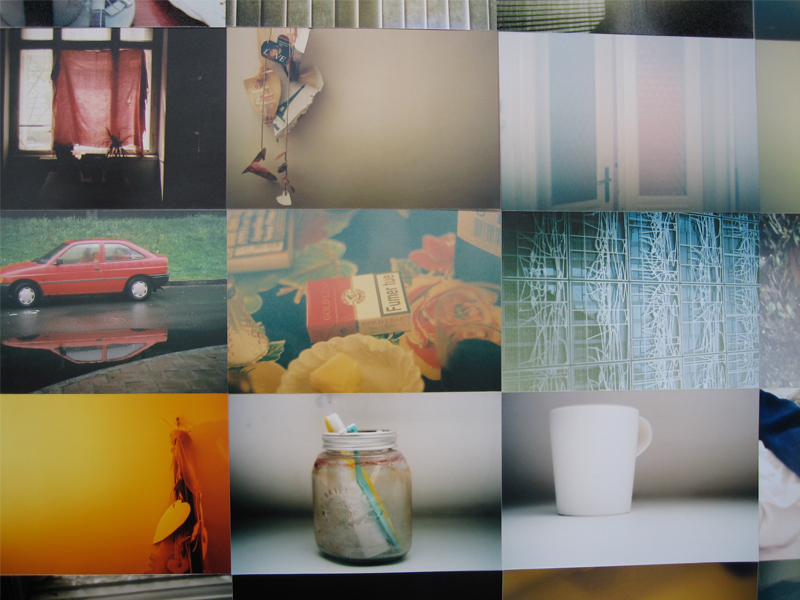 materials and finished garments. Her third piece is a wall of hazy, desaturated photographs of objects and places, entitled Memory Archive. The photos, carefully composed and arranged, have a dreamy, evocative effect.
Nina Mayer's When I Met the President consists of a series of photographs printed to fabric and hung from hooks, childhood images tangled and folded into unrecognizable smears of color. Heather Boaz's two pieces, Escape and Defense, are placed respectively on the "exterior" and "interior" sides of the exhibition and appropriately represent conceptual extremes. Escape is a hanging window with a bed sheet rope hanging from it, while Defense is a doorless knob with a chair jammed anxiously against it. The problem with both pieces is that their narrative is too strongly implied and simplistic. One can understand everything they need to know about the pieces before moving on to the next one, and little thought or analysis lingers onward.
The two sides of the exhibition are linked by a huge hanging sculpture by Ginny Huo. Corrugated Roof consists of three accordion-like sheets of black paper sagging from the ceiling. One's first impression may be that of a surreal tunnel, but the title brings new meaning to the piece, the bleak impression of a bowing roof and a collapsing home, a crushing and suffocating space.
In total, the eerie and haunting pieces on display at Dwelling leave a memorable mark on the brain. The exhibition runs from September 6th to October 19th and is certainly worth a visit the next time you find yourself thinking about home.
Tuesday, September 6, 2011
THUMBS UP / THUMBS DOWN
THUMBS UP
 I’ve spent the last few weeks of a remarkably unproductive summer watching the first three seasons of HBO’s The Wire. It’s been said many, many times before by people more reputable than I, but The Wire is likely the greatest television show ever created. Following the complex worlds of drugs, law enforcement, money and politics in an unflinchingly realistic portrayal of the city of Baltimore, The Wire is a startlingly relevant appraisal of America’s modern urban nightmare, conveyed by some of the best writers and actors you’ll find on TV.
THUMBS DOWN
It’s been a couple of years since I’ve read it, but last week I found myself talking to someone about Dan Brown’s hugely popular novel, The Da Vinci Code. Reading it was one of the most infuriating literary experiences I’ve ever had and I’ve never been able to understand its appeal. I must say, I only finished out of spite. The plot, centering on a historical conspiracy, is inane and driven by its own repetition and pointless forward motion. It feigns intelligence and depth and its characters are laughably undeveloped, collapsing entirely if removed from the weak structure of the narrative.
I’ve spent the last few weeks of a remarkably unproductive summer watching the first three seasons of HBO’s The Wire. It’s been said many, many times before by people more reputable than I, but The Wire is likely the greatest television show ever created. Following the complex worlds of drugs, law enforcement, money and politics in an unflinchingly realistic portrayal of the city of Baltimore, The Wire is a startlingly relevant appraisal of America’s modern urban nightmare, conveyed by some of the best writers and actors you’ll find on TV.THUMBS DOWN
It’s been a couple of years since I’ve read it, but
last week I found myself talking to someone about Dan Brown’s hugely popular novel, The Da Vinci Code. Reading it was one of the most infuriating literary experiences I’ve ever had and I’ve never been able to understand its appeal. I must say, I only finished out of spite. The plot, centering on a historical conspiracy, is inane and driven by its own repetition and pointless forward motion. It feigns intelligence and depth and its characters are laughably undeveloped, collapsing entirely if removed from the weak structure of the narrative.
Subscribe to:
Posts (Atom)