Tuesday, September 27, 2011

CURTIS (REVISED)

Curtis Mayfield's remarkable debut album begins with the singer calling out over a fat bass line, "Sisters! Niggers! Whities! Jews! Crackers! Don't worry, if there's a Hell below, we're all gonna go!" A mixed message, to be sure. Mayfield is defined by them, perhaps the only singer who could make drug dealing street tales and warnings of damnation sound downright soothing, with the aid of his silky, featherlight voice.

Curtis (1970) was released a year before Mayfield left the Impressions but he'd already spent his last albums with the soul group laying the groundwork for his debut with a series of socially and politically anthemic pop songs. Curtis is a uniquely ambitious effort though. "(Don't Worry) If There's a Hell Below, We're All Gonna Go" delivers a dire message over a blisteringly funky groove, as if Mayfield expects us to dance into hell.

That mad, rhythm-driven energy is only tapped a few more times during the album's 40 minutes, Mayfield instead opting often for a softer, richer sound to address social concerns as wide ranging as the decaying of America's cities ("The Other Side of Town") and the need to celebrate black women ("Miss Black America"). "We the People Who Are Darker Than Blue" strikes a moody balance between these extremes, its painful dirge split down the middle by a galloping, rhythmic bridge.

When not in a political mindset, Curtis wanders into slightly saccharine territory, but these diversions are still gorgeous and welcome. Beginning with a harp and horn laden intro straight out of a Disney musical, "The Makings of You" sees Mayfield singing of roses, sugar and "the joy of children laughing around you". Album closer "Give It Up" presents a portrait of a failing marriage over an oddly casual and comforting ramble of guitar and harp, though the hurt in Mayfield's voice is undeniably heartbreaking during the song's mournful chorus: "the warmth of embraces, and the love of our faces / it never happened, you see."

"Move On Up" is arguably the album's centerpiece and one of Mayfield's most well known songs. Its first half is celebratory pop perfection, a perpetual climax riding on an unmistakable and ebullient horn section and Mayfield's pep talk lyrics: "Move on up / And keep on wishing / Remember your dream / Is your only scheme / So keep on pushing." At the four minute mark, its components reconfigure into a frantic, extended jam, the rhythm and irresistible motion of it sounding like a thrilling cross between funk, afrobeat and more modern styles of dance music still years off from 1970.


As he would prove again two years later with his soundtrack to the film "Super Fly" - a catalog of the wild highs and lows of a typical drug dealer, ten years ahead of the war on drugs and fifteen years ahead of gangsta rap - Mayfield understood the soul of urban America better than most, and these songs still feel remarkably relevant and important today. With his combination of reassuringly smooth sounds and delicately powerful words, Mayfield recognized the worries and fears of a troubled America and answered them with positivity, thoughtfulness and dignity.

Monday, September 19, 2011

CURTIS

Curtis Mayfield's remarkable debut album begins with the singer calling out over a fat bass line, "Sisters! Niggers! Whities! Jews! Crackers! Don't worry, if there's a Hell below, we're all gonna go!" A mixed message, to be sure. Mayfield is defined by them, perhaps the only singer who could make drug dealing street tales and warnings of damnation sound downright soothing, with the aid of his silky, featherlight voice.

Curtis (1970) was released a year before Mayfield left the Impressions but he'd already used his last few years with the soul group to lay the groundwork for his debut, writing a series of socially and politically anthemic pop songs. Curtis is a uniquely ambitious effort though. "(Don't Worry) If There's a Hell Below, We're All Gonna Go" delivers its dire message over a blisteringly funky groove, as if Mayfield expects us to dance into hell.

The mad, rhythm-driven energy which defines the opening track is only glimpsed a few more times on the record, Mayfield instead opting for a softer, gentler sound to address social concerns as wide ranging as the decaying of America's cities ("The Other Side of Town") and the need to celebrate black women ("Miss Black America"). "We the People Who Are Darker Than Blue" strikes a balance between the two sounds, its painful dirge split down the middle by a galloping, rhythmic bridge.

When not in a political mindset, Curtis, wanders into slightly saccharine territory, but these diversions are still gorgeous and welcome. Beginning with a harp and horn laden intro straight out of a Disney musical, "The Makings of You" sees Mayfield singing of roses, sugar and "the joy of children laughing around you". Album closer "Give It Up" presents a portrait of a failing marriage over an oddly casual and comforting ramble of guitar and harp, though the hurt in Mayfield's voice when he sings "the warmth of embraces, and the love of our faces / it never happened, you see" is undeniably heartbreaking.

"Move On Up" is arguably the album's centerpiece and one of Mayfield's most well known songs. Its first half is pop perfection, a perpetual climax riding on an unmistakable and ebullient horn section and Mayfield's pep talk lyrics. The uplifting message and celebratory tone of the song presents a striking contrast to the album's darker moments. At the four minute mark, its components reconfigure into a frantic, extended jam, the rhythm and irresistible motion of it sounding like a thrilling cross between funk, afrobeat and more modern styles of dance music still years off from 1970.


What's so remarkable about these songs is how well they hold up and how relevant their messages still seem. As he would prove again two years later with his soundtrack to the film "Super Fly" - a catalog of the wild highs and lows of a typical drug dealer, ten years ahead of the war on drugs and fifteen years ahead of gangsta rap - Mayfield understood the soul of urban America better than most. With its combination of reassuringly smooth sounds and delicately powerful words, Mayfield recognized the worries and fears of a troubled America and answered them with positivity, thoughtfulness and dignity.

Monday, September 12, 2011

DWELLING


Dwelling is a brief but enveloping new exhibition at Columbia's C33 Gallery, examining how we process home, space and memory. "Dwelling", like few other words one could use to describe a home, implies action, an action constantly being performed, the act of living within a space. When we dwell, we strive to impress ourselves upon that space, and allow that space to impress itself upon us. The pieces on display at C33 represent how a diverse collection of artists view our relationship with the places where we dwell.

Arranged in a horseshoe within the gallery, the works form a progressive, exploratory sequence, beginning the with the exterior, material concepts of what we consider home. These pieces are perhaps the most viscerally, immediately affecting of the exhibition, tapping into the highly relevant and always provocative theme of voyeurism. Brandy Watts' untitled digital video installation consists of nighttime images of a home's exterior as seen from the bushes and trees of its yard. The lights are on and there is a sense of life beyond the windows but no person is ever glimpsed. Outside of the windows, however, there is constant motion and sound, provided by the shifting plant life, the rushing wind, the soft glow of moonlight, creating a simulation of a voyeur's serenity.

Jutta Strohmaier's video projection, Passenger, pulls the perspective inside but strikes a similarly serene, peaceful tone, composed of photos taken every minute by a digital camera positioned in an empty room, facing two windows. The scene outside the room is a shifting canvas of light and ghostly images, projecting itself through the windows and onto the blank, white, unchanging space of the room, creating a powerful sense of movement in time as observed from the safe vantage point of a static space. Olga's Chernysheva's Windows is another voyeuristic video piece, though it lacks the serenity of the others, its unwitting subjects living out mundane lives in front of the detached, security camera-like lens of the artist, creating an effect that is more dulling than it is provocative.

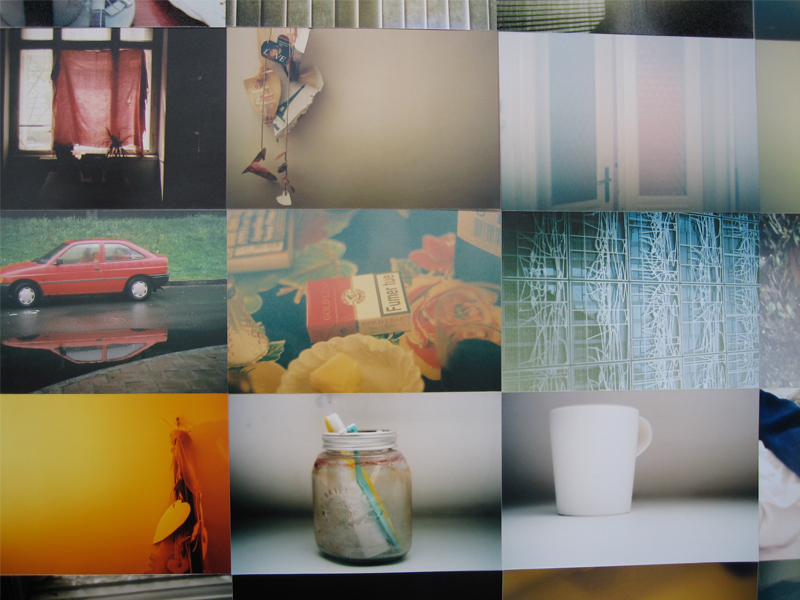
As the exhibit progresses, it becomes more concerned with the memories that become attached to spaces. Carrie Schneider's Family Videos eerily abstract and detach domestic scenes from their context - a sibling being crushed by their brother, a father washing his adult daughter's hair - making them uncomfortable but fascinating. Anna Katherine Peters' family videos, as seen in I'm Filling Up the Holes, are from deep in her past, faded and distorted in both image and memory. The Dress Project sees Peters picking up the dress-making project her mother abandoned 30 years ago in order to find connection between their lives, displayed as a narrative arrangement of text, materials and finished garments. Her third piece is a wall of hazy, desaturated photographs of objects and places, entitled Memory Archive. The photos, carefully composed and arranged, have a dreamy, evocative effect.

Nina Mayer's When I Met the President consists of a series of photographs printed to fabric and hung from hooks, childhood images tangled and folded into unrecognizable smears of color. Heather Boaz's two pieces, Escape and Defense, are placed respectively on the "exterior" and "interior" sides of the exhibition and appropriately represent conceptual extremes. Escape is a hanging window with a bed sheet rope hanging from it, while Defense is a doorless knob with a chair jammed anxiously against it. The problem with both pieces is that their narrative is too strongly implied and simplistic. One can understand everything they need to know about the pieces before moving on to the next one, and little thought or analysis lingers onward.

The two sides of the exhibition are linked by a huge hanging sculpture by Ginny Huo. Corrugated Roof consists of three accordion-like sheets of black paper sagging from the ceiling. One's first impression may be that of a surreal tunnel, but the title brings new meaning to the piece, the bleak impression of a bowing roof and a collapsing home, a crushing and suffocating space.

In total, the eerie and haunting pieces on display at Dwelling leave a memorable mark on the brain. The exhibition runs from September 6th to October 19th and is certainly worth a visit the next time you find yourself thinking about home.

Tuesday, September 6, 2011

THUMBS UP / THUMBS DOWN

THUMBS UP

I’ve spent the last few weeks of a remarkably unproductive summer watching the first three seasons of HBO’s The Wire. It’s been said many, many times before by people more reputable than I, but The Wire is likely the greatest television show ever created. Following the complex worlds of drugs, law enforcement, money and politics in an unflinchingly realistic portrayal of the city of Baltimore, The Wire is a startlingly relevant appraisal of America’s modern urban nightmare, conveyed by some of the best writers and actors you’ll find on TV.

THUMBS DOWN

It’s been a couple of years since I’ve read it, but last week I found myself talking to someone about Dan Brown’s hugely popular novel, The Da Vinci Code. Reading it was one of the most infuriating literary experiences I’ve ever had and I’ve never been able to understand its appeal. I must say, I only finished out of spite. The plot, centering on a historical conspiracy, is inane and driven by its own repetition and pointless forward motion. It feigns intelligence and depth and its characters are laughably undeveloped, collapsing entirely if removed from the weak structure of the narrative.