
Dwelling is a brief but enveloping new exhibition at Columbia's C33 Gallery, examining how we process home, space and memory. "Dwelling", like few other words one could use to describe a home, implies action, an action constantly being performed, the act of living within a space. When we dwell, we strive to impress ourselves upon that space, and allow that space to impress itself upon us. The pieces on display at C33 represent how a diverse collection of artists view our relationship with the places where we dwell.
Arranged in a horseshoe within the gallery, the works form a progressive, exploratory sequence, beginning the with the exterior, material concepts of what we consider home. These pieces are perhaps the most viscerally, immediately affecting of the exhibition, tapping into the highly relevant and always provocative theme of voyeurism. Brandy Watts' untitled digital video installation consists of nighttime images of a home's exterior as seen from the bushes and trees of its yard. The lights are on and there is a sense of life beyond the windows but no person is ever
 glimpsed. Outside of the windows, however, there is constant motion and sound, provided by the shifting plant life, the rushing wind, the soft glow of moonlight, creating a simulation of a voyeur's serenity.
Jutta Strohmaier's video projection, Passenger, pulls the perspective inside but strikes a similarly serene, peaceful tone, composed of photos taken every minute by a digital camera positioned in an empty room, facing two windows. The scene outside the room is a shifting canvas of light and ghostly images, projecting itself through the windows and onto the blank, white, unchanging space of the room, creating a powerful sense of movement in time as observed from the safe vantage point of a static space. Olga's Chernysheva's Windows is another voyeuristic video piece, though it lacks the serenity of the others, its unwitting subjects living out mundane lives in front of the detached, security camera-like lens of the artist, creating an effect that is more dulling than it is provocative.
As the exhibit progresses, it becomes more concerned with the memories that become attached to spaces. Carrie Schneider's Family Videos eerily abstract and detach domestic scenes from their context - a sibling being crushed by their brother, a father washing his adult daughter's hair - making them uncomfortable but fascinating. Anna Katherine Peters' family videos, as seen in I'm Filling Up the Holes, are from deep in her past, faded and distorted in both image and memory. The Dress Project sees Peters picking up the dress-making project her mother abandoned 30 years ago in order to find connection between their lives, displayed as a narrative arrangement of text,
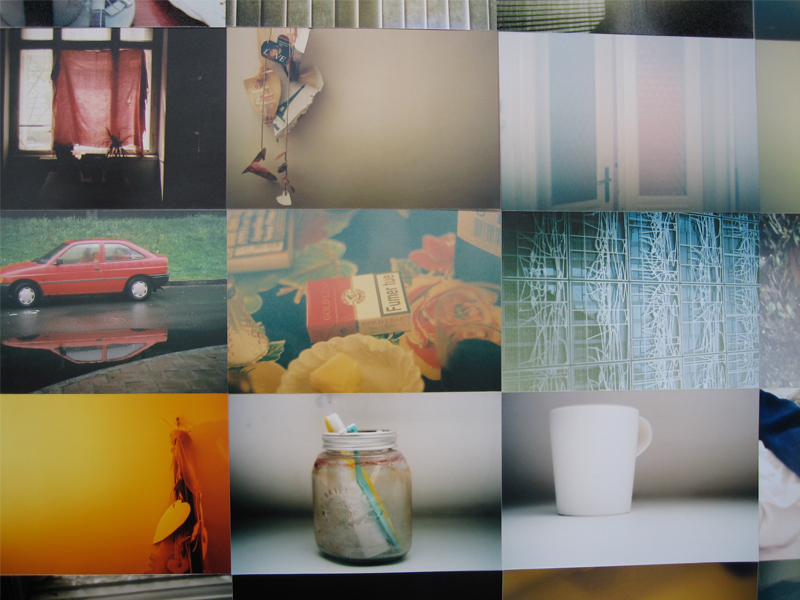 materials and finished garments. Her third piece is a wall of hazy, desaturated photographs of objects and places, entitled Memory Archive. The photos, carefully composed and arranged, have a dreamy, evocative effect.
Nina Mayer's When I Met the President consists of a series of photographs printed to fabric and hung from hooks, childhood images tangled and folded into unrecognizable smears of color. Heather Boaz's two pieces, Escape and Defense, are placed respectively on the "exterior" and "interior" sides of the exhibition and appropriately represent conceptual extremes. Escape is a hanging window with a bed sheet rope hanging from it, while Defense is a doorless knob with a chair jammed anxiously against it. The problem with both pieces is that their narrative is too strongly implied and simplistic. One can understand everything they need to know about the pieces before moving on to the next one, and little thought or analysis lingers onward.
The two sides of the exhibition are linked by a huge hanging sculpture by Ginny Huo. Corrugated Roof consists of three accordion-like sheets of black paper sagging from the ceiling. One's first impression may be that of a surreal tunnel, but the title brings new meaning to the piece, the bleak impression of a bowing roof and a collapsing home, a crushing and suffocating space.
In total, the eerie and haunting pieces on display at Dwelling leave a memorable mark on the brain. The exhibition runs from September 6th to October 19th and is certainly worth a visit the next time you find yourself thinking about home.

All this writing was so eloquent and I enjoyed your critique of the exhibit a lot.
ReplyDeleteTitchener’s Star Rating:
ReplyDeleteOPENING: ☆
IDENTIFICATION: ☆
SUMMARY: ☆
OPINION: ☆
CLOSING: 1/2
TOTAL: ☆☆☆☆ 1/2
You are a very good writer and clearly have a skill for analyzing concisely through writing. I really enjoy your intro, I know in class it was mentioned that you over used act/action, but I like that, it adds some drama to it. You identifications and summaries are great, but as was mentions the numerous amount does get a bit tedious. You're opinion is clear and appreciated, you can tell you really thought through the pieces you mention. The closing seems weak and easy when compared to the level of writing that the rest of the entry is on. Despite that this is a near perfect review.
Sean, I hope you got some useful perspectives on this excellent review in workshop. Thanks for starting us off strong.
ReplyDelete